Alongside English: Why Chinese May Become Humanity’s Second Language
If humanity needed only one language, it would be English. If it needs a second, the strongest case is for Chinese — argued from linguistics, civilization, business and the future of communication.
Abstract
This paper examines a nested conditional proposition: if humanity needed only one common language, it would be English; if humanity needed a second, it might be Chinese. The paper does not argue that Chinese will replace English. English as the first lingua franca is the premise of the whole argument, and every section answers a single question: which language comes second, and why.
The central claim is that choosing “the only one” and choosing “the second” follow different logics. The only one is chosen for total coverage and network effects. English has about 1.49 billion users, roughly three quarters of them second-language speakers, and it is locked in as the standard of science, aviation, the internet and international organizations. The second is chosen for marginal gain beyond English, complementarity with English, and accessibility. On these criteria Chinese stands out. About 84% of its 1.18 billion users are native speakers, and English proficiency in China is low, which makes Chinese the largest “native population block” outside English. Even if nearly half of Chinese speakers also spoke English, the gain from Chinese would still exceed the entire speaker base of any other candidate. Weighting by economic size and knowledge output makes the result stronger.
Chinese also has a property no other candidate shares. Chinese characters are a picture script that conveys meaning through form, so they can be shared across differences of pronunciation. For centuries, Chinese speakers of mutually unintelligible dialects, and scholars in Japan, Korea and Vietnam, used one writing system; faced with new things, the same system keeps producing new characters and words on the same principles.
The paper tests these criteria through four lenses — linguistic theory, civilizational evolution, business competition and future human communication — compares Chinese with Spanish, French, Arabic and Hindi, answers the six strongest objections, and states four conditions under which the word “might” holds: openness, vitality, reachable digital content and continued learnability. Each condition is observable, and each could prove the thesis wrong.
Keywords: lingua franca; second language; English; Chinese; marginal communicative value; form-based script; global language system
1. Introduction
1.1 Why ask about the second language
Globalization has turned a common language into public infrastructure. Trade, research, migration, travel, and now artificial intelligence and global governance all depend on cheap communication across languages. Like telephone networks and the internet, languages have network externalities: the more people use one, the more useful it is to each user (Church & King, 1993). Humanity therefore does not let a hundred flowers bloom when it comes to common languages; it converges on a very small number of them.
Among that small number, the position of English is settled. The Dutch sociologist de Swaan (2001) describes the world’s languages as a layered “galaxy” with English as its only “hypercentral” language, and Crystal (2003) calls English the first truly global language. The question that is both meaningful and genuinely contested is the next one: beyond English, what else does humanity need?
Three developments make that question urgent. First, the centre of gravity of the world economy and of knowledge production is moving east; the “great convergence” that has shifted manufacturing and income back toward Asia since the late twentieth century (Baldwin, 2016) makes the world English does not reach more important every year. Second, a unipolar English order has costs of its own: it concentrates the risk of global communication on a single hub, and it gives native speakers a structural linguistic privilege (Van Parijs, 2011). Third, machine translation and generative AI are changing the costs and benefits of learning languages, and one scholar has predicted that English will be the “last lingua franca” (Ostler, 2010). We therefore need to say clearly why a second language is still needed and, if it is, which one.
The question matters differently to different people. For an individual, it is where to invest limited learning time after English. For national education systems, it is how to design second-foreign-language curricula. For international Chinese education, it is whether its theoretical foundation holds.
1.2 The structure of the proposition
The proposition is a nested conditional. The first choice is made on a blank slate: if there can be only one, which? The second is made after English has already been chosen: in a world that already has English, which language should be added? The two choices obey different criteria. Confusing them is a basic flaw in much of the debate. Citing Spanish’s many official-language countries or French’s standing in international organizations as reasons for either to be the second language answers the second question with the criteria of the first.
The two halves of the proposition also differ in mood. The first says English would be the one; the second says Chinese might be the second. The first is a judgement about the present, the second a judgement about a trend whose truth depends on conditions. This paper does not hide the difference. It treats the conditions under which “might” holds as part of the argument and sets out four observable, falsifiable conditions in Section 11. A thesis without boundaries cannot persuade specialists; a thesis that states its boundaries can be tested.
The paper’s position must be stated plainly: it does not argue that Chinese will replace English. English as the first lingua franca is the premise, and the whole argument answers only the question of what comes second. This is not modesty. Section 3 shows that the position of English is fixed by network effects and institutional lock-in and will not change in the foreseeable future, and the language-competition models in Section 8 show that there is room for only one “only one”.
Finally, “need” here means functional need. A common language is a tool for communication layered on top of mother tongues; it has nothing to do with replacing mother tongues or reducing linguistic diversity. On the contrary, Section 8 argues that a “first plus second” order is more resilient than English unipolarity and better at preserving the diversity of human thought.
1.3 Research questions and method
The paper asks four questions. What should decide the choice of a single lingua franca, and why does English win? Given English, what should decide the choice of a second? By that standard, does Chinese beat Spanish, French, Arabic, Hindi and the other candidates? What are the strongest objections to Chinese, and can they be answered?
Methodologically, the paper draws on the theory of the global language system, the economics of language, the study of writing systems, cultural evolution and network science, supplemented by multi-indicator comparison. Where data are uncertain it uses dominance reasoning: instead of relying on a precise estimate, it shows that the conclusion holds under the least favourable reasonable assumption. For each claim it tries to supply three things — a theoretical mechanism, checkable evidence, and the strongest counter-case with its limits. All works and data sources cited are listed at the end.
1.4 Outline
Section 2 defines the concepts and builds the framework. Section 3 argues the first proposition, that the one language would be English. Section 4 presents the core argument: Chinese has the largest marginal communicative value. Sections 5 to 8 test that argument through linguistic theory, civilizational evolution, business competition and future human communication. Section 9 compares Chinese with the other candidates, Section 10 answers the strongest objections, and Section 11 states the conclusions, the conditions and the implications.
2. Concepts and Framework
Choosing “the only one” and choosing “the second” are different problems: the first maximizes total coverage, the second maximizes the gain beyond English and the complementarity with English. This distinction is the pivot of the whole argument; the diagram below summarizes the paper’s structure.
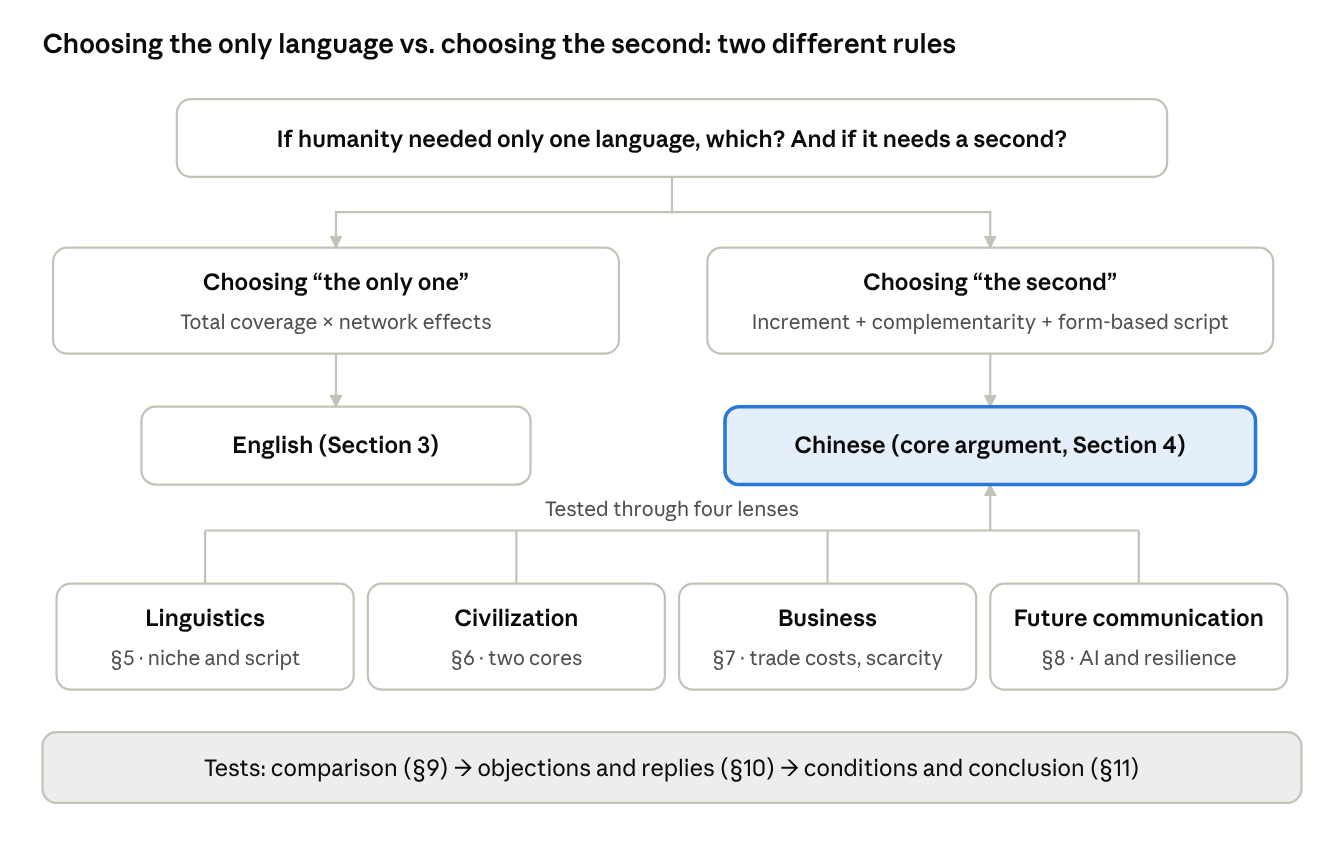
Figure: Structure of the argument · two selection rules, four lenses, three tests
The left branch yields English and the right branch yields Chinese. The four lenses serve only the right branch, because the first proposition is a judgement about the present, while the second is the one that needs to be argued.
2.1 Lingua francas and the global language system
A lingua franca is a common language used for communication between people whose mother tongues differ. This paper is concerned only with global lingua francas — languages used across countries and continents in science, business, diplomacy and everyday exchange.
The standard framework for this question is de Swaan’s (2001) “global language system”. In it, the great majority of the world’s languages are peripheral. They are linked by multilingual speakers to central languages, which are in turn linked to about a dozen supercentral languages, among them Chinese, Spanish, French, Arabic, Hindi and Russian. At the top, connecting all the supercentral languages, sits the single hypercentral language: English. The links are made by multilingual people. The more a language is learned by speakers of other languages, the higher its position in the system.
In these terms the proposition can be restated: English is the only hypercentral language, and among the supercentral languages Chinese has the strongest claim to be the system’s “second pole”.
de Swaan also proposes a measure of a language’s communicative value, the Q-value:
Here is prevalence, the share of the population who speak language i, and is centrality, the share of multilingual speakers who speak language i. Prevalence measures how many people speak a language; centrality measures how many use it as a bridge. Section 4 shows that Chinese combines high prevalence with low centrality, and that this is an advantage for a second language rather than a weakness.
In this paper, “users” include native speakers (L1) and second-language speakers (L2). “Chinese” means Mandarin (Modern Standard Chinese) together with its character-based writing system. “Need” is measured by four functions: reach of communication, economic opportunity, access to knowledge, and understanding of civilizations.
2.2 Two logics of choice
The first logic governs the choice of the only one. If all of humanity could share only one language, it should choose the one that already connects the most people and is hardest to replace. Choosing a language is a coordination game: which language each person learns depends on what others learn (Selten & Pool, 1991). Once a language passes a critical size, each additional learner makes it more valuable to the next, and the equilibrium reinforces itself (Church & King, 1993). The criterion for the first lingua franca is therefore total coverage times network effects.
The second logic governs the choice of the second. Once English has been chosen, the value of learning another language depends not on how “international” it is in itself but on how many people, markets and bodies of knowledge it adds that English does not reach. In asking how many languages humanity needs, Ginsburgh & Weber (2011) measure a set of languages by its “disenfranchisement rate” — the share of people it leaves out. Borrowing that idea, the choice of a second language can be written as:
Here is the set of users of language L and the set of English users, so only the part English does not cover is counted. is a weight: it can be 1 (a head count) or reflect income or knowledge output. The meaning is simple: the second language is the one that most reduces the number of people left out of global communication.
The two logics can point to very different answers. A language widely used in international organizations adds little at the margin if most of its users already speak English. A language with few foreign learners but a huge native population that rarely speaks English adds a great deal. The first scores well under the first logic, the second under the second logic. The proposition asks the second question.
2.3 Three criteria and one unique property
Following the second logic, the paper judges candidates by three criteria.
- Marginal gain: how large a share of the world’s population, economy, science and digital space the language covers outside English. This is the core argument of Section 4.
- Complementarity: how different the language is from English in civilization, script and linguistic type. The greater the difference, the more of human experience “English plus X” covers — just as, in a portfolio, the lower the correlation between two assets, the greater the benefit of diversification.
- Accessibility: the cost of learning, together with the infrastructure of transmission — textbooks, tests, technology and institutions.
In addition, Chinese has a property no other candidate shares: a form-based script that works across pronunciations. Chinese characters, which convey meaning through form, can be used in common by people who pronounce them differently, and have historically served as a written lingua franca across dialects and national borders. Sections 5 and 6 argue this from the theory of writing and from history.
2.4 Four lenses
The three criteria need to be tested at different levels. The paper uses four lenses: linguistic theory examines language and script themselves; civilizational evolution examines the long run of history; business competition examines incentives and costs; future human communication examines technology and risk. Each lens tests several criteria at once.
| Lens | Core theoretical tools | Criteria mainly tested | Section |
|---|---|---|---|
| Linguistic theory | Linguistic niche hypothesis, information theory, theory of writing systems, cognitive science | Complementarity, accessibility, form-based script | 5 |
| Civilizational evolution | Civilizational cores, the Axial Age, the collective brain | Complementarity, marginal gain, form-based script | 6 |
| Business competition | Gravity models of trade, local knowledge, structural holes, network industries | Marginal gain, accessibility | 7 |
| Future human communication | The machine-translation debate, network resilience, language-competition dynamics | Marginal gain, complementarity, accessibility | 8 |
The comparison in Section 9 turns these criteria into concrete indicators: learning cost, overlap with the English-speaking network, third-party rankings, and core strengths and weaknesses.
3. The First Proposition: Why the One Language Would Be English
If all of humanity could share only one language, English is the only realistic answer. The reason is not that English is “best” but that it crossed the network threshold first and has been locked in by a whole set of institutions. This section shows this through scale, structure, history, institutions and knowledge production.
3.1 Scale and spread: the world’s largest second-language community
According to Ethnologue (2026), English has about 1.493 billion users: about 372 million native speakers and about 1.121 billion second-language speakers. Its L2 speakers outnumber its L1 speakers three to one and are more than three times the world’s next-largest L2 community (Modern Standard Arabic, about 335 million). English is an official language in 58 sovereign states and 28 non-sovereign entities on every continent (Wikipedia, 2026a).
What these numbers mean matters more than the numbers themselves. A lingua franca is by nature “someone else’s language”, a tool borrowed by people with different mother tongues. That English has far more second-language than native speakers shows how far it has been “denationalized”: much of today’s English-language communication takes place between non-native speakers, which is the starting point of research on English as a Lingua Franca (Seidlhofer, 2011).
3.2 Structure: a language “polished” by outsiders
An important finding of sociolinguistic typology is that when a language is acquired as a second language by large numbers of adults, its morphological complexity is reduced (Trudgill, 2011). English is a case in point. Through long contact with Old Norse and Norman French, it lost grammatical gender, reduced noun case to the genitive and pronoun case, and greatly simplified verb inflection. McWhorter (2007) lists English among his five cases of languages shaped by large-scale non-native acquisition. Together with a 26-letter Latin alphabet and an open vocabulary that readily absorbs loanwords, this gives English a relatively low entry threshold.
Its weaknesses must be acknowledged just as openly. English spelling corresponds very irregularly to pronunciation, and its idioms are numerous. Native speakers therefore enjoy a structural linguistic privilege in international exchange, which amounts to a form of linguistic injustice (Van Parijs, 2011). These weaknesses have not shaken the position of English, which shows that its position rests on network effects, not on any intrinsic superiority of the language.
3.3 History: two imperial relays
English is the first lingua franca in history to be spoken on every continent (Ostler, 2010). Its expansion came in two relays: in the nineteenth century Britain carried it across the world, and in the twentieth century the United States took over through its economy, technology, popular culture and the post-war international order (Crystal, 2003). The industrial revolution, the institutions of modern science and the internet all matured in the English-speaking world, making English the master copy of modern knowledge. The two relays combined gave English both the breadth of a colonial legacy and the height of the post-war order.
3.4 Institutions: a language written into the rules
Once network effects have formed, institutions harden them. In game-theoretic terms, language learning is a coordination game; once the equilibrium settles on English, everyone’s best choice is to keep learning English (Selten & Pool, 1991; Church & King, 1993). Van Parijs (2011) adds a “maximin” mechanism: multilingual groups tend to choose the language best known by the member who knows it least well. Every multilingual meeting, negotiation and partnership thus casts another vote for English.
The choice has been written into the rules of whole industries. In 2003 the International Civil Aviation Organization amended the annexes to the Chicago Convention to require pilots and air-traffic controllers in international operations to reach Operational Level 4 in English (Wikipedia, 2026b). The International Maritime Organization’s Standard Marine Communication Phrases are based on English, and the working languages of the UN Secretariat are English and French. Once written into rules, changing language is no longer an individual choice but a collective action problem for an entire industry.
3.5 Knowledge and digital production: humanity’s main memory
In science, more than 90% of indexed articles in the natural sciences are published in English; the same study found that, within the same journals, non-English papers are markedly less likely to be cited (Di Bitetti & Ferreras, 2017). The citation incentive pushes still more researchers toward English, closing a self-reinforcing loop.
In the digital world, 49.5% of websites whose content language is known use English (W3Techs, 2026), and English pages make up about 41.9% of the latest Common Crawl snapshot of the public web, CC-MAIN-2026-39 (Common Crawl, 2026). Such public web data are a major source of training data for large language models, which has also made English the default language of human–machine communication.
3.6 Summary: the strength and limits of the first proposition
The position of English is held by five locks — population, structure, history, institutions and knowledge — which reinforce one another. Replacing English would require all five to turn at once, which is unimaginable in the foreseeable future. That is why this paper takes the first proposition as its premise and does not discuss replacement.
At the same time, the “only one” status of English comes from historical path and network effects, not from any intrinsic superiority. This fixes the rules of competition for the second language: it cannot compete with English on totals, only on increments. The next section starts from there.
4. The Core Argument: Chinese Has the Largest Marginal Communicative Value
Among the people English does not reach, Chinese speakers form the largest block: about 1.18 billion people, nearly twice the third-largest language, Hindi (about 611 million), and more than 80% of them native speakers. This is the most important argument in the paper; every other section tests or extends it.
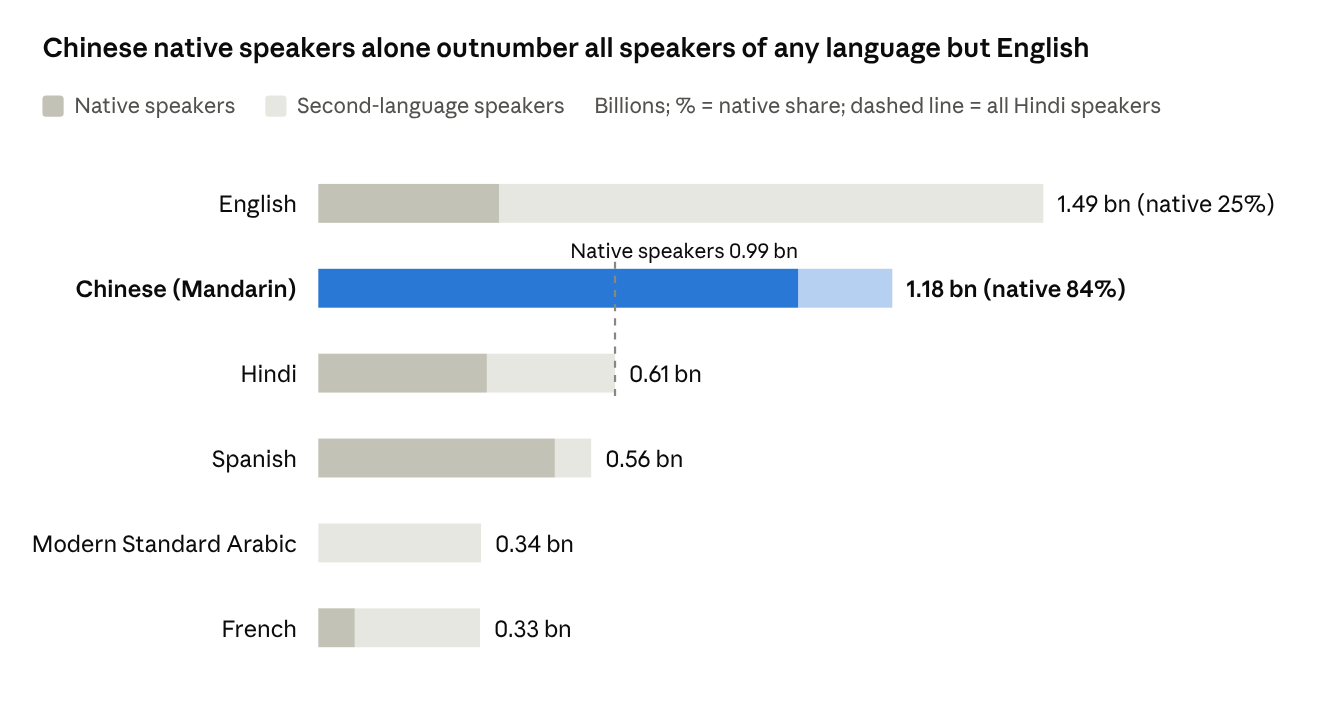
Figure: Data: Ethnologue (2026), as compiled by Wikipedia; see References · totals are the published figures
Chinese is highlighted: its native-speaker segment alone is longer than the entire bar of any language other than English.
4.1 The facts: two very different population structures
According to Ethnologue (2026), Chinese (Mandarin) has about 1.183 billion users, including about 988 million native speakers — the most of any language — and about 194 million second-language speakers, mostly people in China whose mother tongue is another Chinese variety or a minority language. After English and Chinese, no language has more than 700 million users: Hindi has about 611 million, Spanish about 561 million, Modern Standard Arabic about 335 million and French about 334 million.
The structure is even more telling. About three quarters of English users are second-language speakers; English is a global shared layer. About 84% of Chinese users are native speakers; Chinese is a native population block that English barely reaches. One is an “L2-type” language, the other an “L1-type” language. Their population structures are complementary, and that is the structural reason why the gain from Chinese is the largest.
4.2 A robustness argument: dominance without precise estimates
To compute the gain from Chinese we would need to know what share of Chinese speakers can communicate in English. Call this share x. There is no precise figure for x, but the argument does not need one. We ask only how large x would have to be for some other candidate to overtake Chinese. To make the test as hard as possible, assume every other candidate has no overlap with English at all, so that all its users count as gain. The strongest rival is Hindi:
In other words, as long as no more than about half of Chinese speakers speak English, the gain from Chinese exceeds the entire user base of any other candidate. The real x is far below this threshold: the EF English Proficiency Index 2025 places China in the “low proficiency” band, with a score of 464 among 123 countries and regions (EF, 2025). No reasonable estimate puts nearly half of China’s population as able to communicate in English.
An even harsher test is possible. Hindi and Urdu are largely mutually intelligible in speech. Adding them together gives about 857 million — an upper bound that double-counts people who speak both. The threshold then falls to about 28%, and Chinese still wins. Moreover, 10.6% of India’s population (about 129 million people) reported speaking English in the census (Census of India, 2011), so the real gain from Hindi–Urdu is far below 857 million. Spanish and French overlap even more with the English-speaking world, so their real gains are smaller still.
The value of this reasoning is that the ranking is insensitive to parameter uncertainty. Whether the true x is 5%, 10% or 20%, the conclusion is unchanged. A conclusion that holds under the least favourable assumption is one that can withstand expert scrutiny.
4.3 Weighted tests: from heads to value
Counting heads is only the first step. For a learner, the value of a language also depends on the economy and knowledge it connects to. Below, the weight in the formula of Section 2 is replaced by economic and knowledge indicators.
Weighted by economic size, China’s nominal GDP is about US$20.85 trillion (2026 estimate, second in the world), and about US$44.29 trillion at purchasing power parity, first in the world; in 2025 China accounted for about 17% of world output in nominal terms and 19% at PPP (IMF, 2026). No single economy in any other non-English language community comes close.
Weighted by knowledge output, the result is just as clear. Global patent applications reached a record of about 3.7 million in 2024. Innovators in China filed about 1.8 million, close to half the world total, followed by the United States (about 502,000), Japan (about 419,000), the Republic of Korea (about 296,000) and Germany (about 133,000) (WIPO, 2025). The great majority of these applications were filed in Chinese. In the Nature Index, which tracks high-quality natural-science research, China’s 2024 Share was 32,122, the highest in the world and 17% above 2023, and eight of the world’s top ten research institutions were Chinese (Nature Index, 2025).
A careful qualification is needed here. Chinese scientists publish mostly in English, so research output measures the size of a research community whose working language is Chinese — in labs, seminars, engineering documents and supervision — not the volume of Chinese-language literature. Patent texts, by contrast, are a direct stock of knowledge written in Chinese.
Under all three weightings — population, economy and knowledge — Chinese ranks first in marginal gain. This is the second layer of robustness in the core argument.
4.4 Answering the centrality objection
The most technical objection to this argument comes from de Swaan’s Q-value. Chinese has few foreign second-language speakers and low centrality, so by the Q-value its global communicative value is depressed.
But the Q-value answers how much bridging a language does among existing multilinguals, whereas the second-language question asks how many people beyond the reach of English a language connects. For the latter question, low centrality is itself the argument: it means that these 1.1 billion people cannot be reached through any other language, and that to reach them one has to learn Chinese. Scarce learners also mean higher individual returns, a point Section 7 develops as a “scarcity premium”.
More important still, the two quantities differ in how far they can change. Centrality can be raised by education and trade, and Section 6 shows that it is rising. A native population block of this size cannot be replicated by any other language.
4.5 Summary
Beyond English, Chinese connects the most people, the largest economy and the most active knowledge production, and this conclusion does not depend on any sensitive parameter. That is the most direct reason why, if humanity needs a second language, it might be Chinese.
5. The Linguistic Lens: Two Complementary Languages Both Suited to Outsiders
Linguistics does not support claims that one language is inherently superior to another, and this paper makes no such claim. What linguistics does support are four other points. English and Chinese are both languages that have been learned by vast numbers of adult outsiders and have become morphologically very simple as a result. They lie further apart in linguistic type and script than any other pair of major languages, so combining them yields the greatest informational gain. Chinese characters are a picture script that conveys meaning through form, can be shared across pronunciations and keeps growing. And the difficulty of Chinese lies at the entry level, not in its structure, which is simple.
5.1 The linguistic niche: large languages evolve lingua-franca forms
Lupyan & Dale (2010) analysed more than 2,000 languages and found that language structure is partly determined by social structure: the more speakers a language has and the wider it is spread, the simpler its inflectional morphology. Languages with more than 100,000 speakers were about six times more likely to have simple verb conjugations than languages with fewer. They called this the “linguistic niche hypothesis”: like organisms, languages adapt to their social environment. The mechanism is that adult second-language learners struggle with complex inflection; when many of them enter a speech community, redundant morphology is worn away within a few generations (Trudgill, 2011).
In Language Interrupted, McWhorter (2007) chose five standard languages as cases of large-scale non-native acquisition: English, Mandarin, Persian, colloquial Arabic and Malay. He notes that, compared with other Chinese varieties, Mandarin has fewer tones, more restrictions on syllable-final sounds, and fewer aspect markers, negators and complementizers, and he attributes these simplifications to large numbers of adults from other ethnic groups moving into northern China and learning Chinese around the Tang dynasty.
This matters a great deal for the proposition. English and Mandarin are exactly the two major languages that history has already “tested” on vast numbers of outsiders. Mandarin has almost no inflection: no tense, case or gender, only a limited and optional plural marker (-men), with grammatical relations expressed mainly by word order and function words. For learners, the structural layer of Mandarin is simple; its difficulties lie elsewhere — in characters and tones. From the perspective of the linguistic niche, it is no accident that humanity’s first two lingua francas fall on these two languages.
5.2 Information theory: no claims about efficiency, only about complementarity
One study must be cited on the question of linguistic “efficiency”. Coupé et al. (2019) measured spoken speech in 17 languages and found that their information rates are remarkably similar, averaging about 39 bits per second. Mandarin is spoken more slowly but carries more information per syllable; languages such as Spanish are spoken faster with less information per syllable, and the two effects cancel out. This paper therefore does not claim that Chinese is “more efficient” to speak. Such claims do not survive expert questioning, and the argument does not need them.
What information theory does offer is a way to formalize complementarity. By analogy, the “new information” a second language brings can be treated as a conditional entropy:
The less mutual information a language shares with English — the less correlated it is — the more new perspective it brings. The analogy can be made measurable: typological distance can be computed from the features in the World Atlas of Language Structures (WALS), and lexical distance from the ASJP database. Spanish, French and German belong with English to the Indo-European family, use the Latin alphabet and share many cognates. Chinese differs from English in family, script, phonology (tone) and grammatical type. On complementarity, Chinese scores highest among all major languages.
5.3 The theory of writing systems: Chinese characters as a form-based picture script
First, a definition. This paper uses “picture writing” in a broad sense: a script whose graphic forms are rooted in images and which conveys meaning mainly through form rather than sound — a form-based script (表形文字). Its counterpart is a sound-based script (表音文字) whose letters record speech sounds. This differs from the narrow usage in Chinese grammatology, where “picture writing” refers to a pre-writing stage (Qiu, 1988). The definition is stated explicitly to move the discussion from terminology to substance.
The essential difference between Chinese characters and English writing lies in what the written form connects to. The form of a Chinese character connects directly to meaning; the form of an English word connects to sound. Saussure (1916) divided the world’s writing into ideographic and phonetic systems and took Chinese as the classic example of the former.
The pictorial roots of Chinese characters are plain to see. About a quarter of oracle-bone characters are pictographs, and the later compound-ideographic and semantic-phonetic characters are mostly built from pictographic components: 林 (lín, “woods”) is two trees, and 河 (hé, “river”) combines “water” with 可 (Wikipedia, 2026c). The character system is, in essence, a combinatorial system of image components.
The evidence that meaning is conveyed through form comes at three levels.
The first is inside the character. Semantic components reliably signal a category of meaning: 氵 relates to water, 木 to trees and wood, 扌 to actions of the hand. Phonetic components, by contrast, have often drifted with sound change: 江 (“river”) takes 工 (gōng) as its phonetic yet is read jiāng today. The cues a reader gets from form are more reliable than the cues from sound.
The second is between users. Chinese dialects are often mutually unintelligible in speech yet share one written language. Scholars from China, Japan, Korea and Vietnam who could not converse long communicated through “brush talk” based on written characters (see Section 6). Trained readers can read texts written more than two thousand years ago, while English readers without special training already struggle with Chaucer, six centuries old. The Latin alphabet writes hundreds of languages but does not let their speakers read one another’s texts; Chinese characters let people with no shared spoken language read the same text. This is the strongest evidence for the difference between form-based and sound-based writing, and the root of the characters’ natural capacity to serve as a written lingua franca.
The third is in the brain. Tan et al. (2005) found that Chinese children’s reading ability depends mainly on writing and visual analysis of character form, with only a minor contribution from phonological awareness — the reverse of the pattern for alphabetic reading, which depends heavily on phonological awareness. The researchers summed it up as learning to read Chinese “by hand” and English “by ear”. A meta-analysis by Bolger et al. (2005) likewise shows that the brain’s reading network has a universal basis but adapts to the writing system. The difference between form-based and sound-based writing has measurable neural and cognitive correlates.
This position must answer mainstream objections — for example, that most modern common characters are semantic-phonetic compounds and that many no longer look like pictures. Section 10.5 answers them one by one. The costs of characters must also be admitted: learners have to memorize thousands of forms, and literacy takes longer to acquire. Pinyin, input methods and AI are now offsetting this cost substantially (see Sections 8 and 10).
5.4 Adaptability: an open system that keeps growing
Chinese characters are not a closed set of pictures but an open system that keeps growing on the same principles. Its capacity to accommodate new things and new situations shows at three levels.
First, new characters. Japan created kokuji (national characters) for native plants, animals and things, such as 榊 (sakaki, “tree” plus “deity”, the sacred tree of Shinto shrines), 畑 (hatake, “dry field”) and 鰯 (iwashi, “sardine”), most of them formed as semantic compounds (Wikipedia, 2026f). Modern Chinese also creates characters for newly discovered chemical elements. The Chinese names announced in 2017 for elements 113, 115, 117 and 118 are 鿭, 镆, 鿬 and 鿫; their semantic components 钅, 石 and 气 mark the categories metal, solid non-metal and gas, while their phonetic components echo the elements’ names. Three of them were subsequently encoded in Unicode 11.0 (Wikipedia, 2026g; Unicode IRG, N2198). A reader who has never seen these characters can still tell from the semantic component what kind of element each is.
Second, new words. New concepts enter Chinese mostly by combining existing morphemes — 电脑 (“electric brain”, computer), 手机 (“hand machine”, mobile phone), 互联网 (“inter-linked net”, internet) — or by borrowing that matches both sound and meaning, as in 基因 (jīyīn, “basic factor”, gene). The vocabulary grows without the number of characters having to grow with it.
Third, re-creation across borders and return flows. During the Meiji era, Japanese scholars translating European works of politics, philosophy, law and science coined, or gave new meanings to, words written in characters such as 哲学 (philosophy), 社会 (society), 经济 (economy), 科学 (science), 革命 (revolution), 电话 (telephone), 银行 (bank) and 共和国 (republic). From the late nineteenth to the early twentieth century these words entered modern Chinese in large numbers through translations and Chinese students in Japan (Wikipedia, 2026h). Some, such as 经济 and 革命, were old Chinese words that acquired modern meanings in Japan. The same meaning-bearing morphemes could be understood directly, re-created and sent back across national borders. This is the openness peculiar to a form-based script: it turns the whole Sinosphere into a shared pool of morphemes.
5.5 Transparency: cognitive dividends in vocabulary and numbers
Chinese word formation is highly transparent. In 飞机 (“flying machine”, aeroplane), 氧气 (“oxygen gas”), 心脏病 (“heart disease”) and 低血糖 (“low blood sugar”), knowing the morphemes is enough to infer the meaning. English technical vocabulary draws heavily on Latin and Greek roots, as in hypoglycemia, which are opaque to non-specialists. Chinese readers therefore face a lower terminological barrier when entering a new field.
The number system is the clearest example. The Chinese word for eleven is literally “ten-one”, so the base-ten structure is obvious; English eleven and twelve hide it. A cross-cultural study by Miller et al. (1995) found that this difference shows up in how easily children learn to count, giving Chinese-speaking preschoolers an early advantage in mathematical competence. This is measurable evidence that language structure affects cognitive development.
The burden of learning characters is front-loaded. Zhou Youguang’s “law of diminishing returns” of Chinese characters states that the 1,000 most frequent characters cover about 90% of text, and each further 1,400 or so reduces the uncovered remainder to a tenth: 2,400 characters cover about 99% and 3,800 about 99.9% (Wikipedia, 2026d). In the List of Frequently Used Characters in Modern Chinese published in 1988, the 2,500 common characters cover 97.97% of text, and adding 1,000 less common ones brings coverage to 99.48% (Wikipedia, 2026e). The main cost falls on the first two or three thousand characters; beyond that, the marginal cost drops quickly.
5.6 Language and worldview: the value of a second language lies in difference
From Humboldt’s (1836) idea that each language embodies a worldview to Wittgenstein’s “The limits of my language mean the limits of my world” (Tractatus 5.6), philosophy has held that learning a new language means gaining a new way of seeing the world, and that the more a new language differs from those one already has, the greater the gain.
Caution is needed here. The strong version of linguistic relativity — that language determines thought — has been rejected. The weak version — that language influences habits of attention and memory — has experimental support but remains contested. This paper uses only the weak version and does not depend on it: even leaving thought aside, an English–Chinese bilingual commands the two most different language-and-script systems, together with the textual traditions each carries.
5.7 Summary
Linguistics does not say that Chinese is better. It says four more concrete things: Chinese and English are both large languages polished by outsiders; they are the most complementary pair; Chinese characters are a form-based script that can be shared across pronunciations and borders and keeps growing; and the barrier to Chinese lies in characters and tones — an entry cost, not a structural one.
6. The Civilizational Lens: Two Cores of Civilization Need a Bilingual Interface
Over the long run, human civilization has always had two cores, one in the West and one in the East. English is the present-day carrier of the Western core; Chinese is the carrier of the Eastern core, unbroken to this day. From the standpoint of civilizational evolution, a second language means building a broadband interface between these two cores.
6.1 Two cores: the long-run norm
The historian Ian Morris (2010) tried to compare East and West quantitatively with a “social development index” built from four traits: energy capture, organization, information technology and war-making capacity. His “West” is the civilizational core that arose in the eastern Mediterranean and later spread to Europe and North America; his “East” is China. He concluded that the West led for most of several thousand years, but that from the sixth century CE to about 1750 the East led for roughly 1,200 years (Long Now Foundation, 2011). The construction of the index is of course disputed, but the finding that two cores took turns in the lead is corroborated by economic history.
Pomeranz’s (2000) “Great Divergence” thesis holds that the gap between Europe and the most advanced regions of China opened decisively only around 1800; Broadberry, Guan & Li (2018), using historical national accounts, estimate that the divergence began earlier. The dating is contested, but both sides agree that for centuries East and West were two powerful and comparable centres. Baldwin (2016) calls the shift of manufacturing and income back towards Asia since the late twentieth century the “Great Convergence”.
Taken together, these studies support a simple inference: English dominance is a phenomenon of the last two centuries, while two cores are the long-run norm. As the centre of gravity of civilization rebalances, a language order that moves from a single pole to “one primary, one secondary” is the linguistic projection of that rebalancing. It does not mean that English’s first place will be shaken. It means that the second core needs a language interface of its own.
6.2 Continuity: more than three thousand years of unbroken civilizational memory
Scholars generally recognize four independently invented writing systems: cuneiform, Egyptian hieroglyphs, Chinese characters and Maya script. Only Chinese characters are still in use. The earliest oracle-bone inscriptions date to the reign of the Shang king Wu Ding, around 1250–1200 BCE (Wikipedia, 2026i).
Jaspers (1949) proposed the idea of the “Axial Age”: between roughly 800 and 200 BCE, Greece, Israel, India and China laid down, almost simultaneously, the intellectual frameworks that still shape humanity. The English-speaking world inherited the first two traditions directly but encounters the latter two mainly through translation. Among these four traditions, the Chinese one has the only writing system that was never interrupted, and the largest community still actively using it. Learning Chinese gives direct access to this tradition in the original, without a translator’s filter. Joseph Needham’s Science and Civilisation in China (1954–) shows the independent scientific and technological lineage that grew within it.
6.3 Historical dual lingua francas: the proposition is not new
A “one primary, one secondary” structure of two lingua francas is not unusual in large historical civilizations.
The Roman Empire is the best-known example. Latin was the language of administration and law; Greek was the lingua franca of the eastern empire and the language of philosophy and science. The Roman elite regarded command of both languages (utraque lingua) as the mark of an educated person (Adams, 2003). In the Islamic world, Arabic was the language of religion and scholarship, while Persian long served as the lingua franca of administration and literature across the vast eastern lands (Green, 2019).
The East Asian case is the most relevant to this paper. Literary Chinese was for more than a thousand years the shared written language of China, Japan, the Korean peninsula and Vietnam. From the Sui dynasty to the early twentieth century, scholars and envoys who could not understand one another’s speech communicated by “brush talk”: each read the characters differently, yet each could understand what the other wrote. Around 1905, the Vietnamese revolutionary Phan Bội Châu met Liang Qichao in Japan. Phan could read and write Classical Chinese, but his Sino-Vietnamese pronunciation was unintelligible to Liang, so the two sat at a table passing sheets of paper covered with characters back and forth (Wikipedia, 2026j). This scene is historical proof that a form-based script can cross the boundaries of pronunciation.
The legacy remains visible today. About 49% of the entries in the Japanese dictionary Shinsen Kokugo Jiten (2002) are Sino-Japanese words (kango). By register, about 35% of the words in entertainment magazines are kango, more than half in newspapers, and 60% in science magazines (Wikipedia, 2026k). The more formal and specialized the register, the more Sino-Japanese vocabulary it uses: within the Sinosphere, Chinese characters remain the language of knowledge.
Large civilizational systems therefore often have a “one primary, one secondary” pair of lingua francas, and Chinese is not a newcomer to the role. It has a thousand-year record as a regional lingua franca. The proposition of this paper amounts to extending that record to the global scale.
6.4 The collective brain: connecting the two largest knowledge networks
Cultural evolution theory holds that a society’s rate of innovation depends on the size and interconnectedness of its “collective brain”: the more people there are and the more tightly they are linked, the more efficiently knowledge is transmitted and recombined (Muthukrishna & Henrich, 2016). The two largest knowledge networks in the world today work in English and in Chinese (see Section 4 for the data). The connectivity between them directly affects how fast humanity as a whole can learn, and English–Chinese bilinguals and translators are the bridges between the two networks.
Diversity is also evolutionary insurance. A system with one language and one intellectual framework is more fragile: once it goes wrong, it is hard to correct. Keeping a mature, independent civilizational “operating system” that differs most from the mainstream is a choice that reduces systemic risk. The French philosopher François Jullien (1995) treats China in exactly this sense as the “outside” of European thought: precisely because Chinese thought developed independently of the Indo-European grammatical framework, it is best placed to expose the assumptions that Western thought takes for granted.
The insight is not new. As early as 1697, in the preface to his Novissima Sinica, Leibniz wrote that he regarded it as a singular arrangement of fate that the highest cultivation and refinement of humankind now seemed concentrated at the two extremes of the Eurasian continent, in Europe and in China (Leibniz, 1697). The proposition of this paper can be read as a linguistic version of that insight.
6.5 Institutionalization: the international presence of Chinese is settling in
Chinese is one of the six official languages of the United Nations. In education, 86 countries had incorporated Chinese into their national education systems by 2025 (China Daily, 2025). By the end of 2023, about 30 million people outside China were learning Chinese, and close to 200 million had learned or used it cumulatively (Jiemian, 2024). Compared with the size of the economy that Chinese connects to, these numbers are still small — which is both a gap and room for growth (see the scarcity premium in Section 7).
6.6 Summary
The civilizational lens lifts the proposition from a comparison of national power to a structural need. A human civilization with two cores needs a bilingual interface; large historical civilizations have often had a primary and a secondary lingua franca; and Chinese already has a thousand-year record as a lingua franca in East Asia, a record built on its form-based script.
7. The Business Lens: Language Is a Trade Cost, and Chinese Is the Largest Unhedged Exposure
Language difference is a measurable trade cost. Beyond English, Chinese connects to the world’s largest trading nation and manufacturer, and very few foreigners know Chinese. Together, these two facts make Chinese the language with the highest marginal business return.
7.1 Language as a trade cost: evidence from gravity models
Gravity models of international trade have long been used to estimate how a common language affects bilateral trade. Egger & Lassmann (2012) pooled 701 estimates from 81 papers; their meta-analysis shows that a common language raises bilateral trade directly by about 44% on average.
Melitz & Toubal (2014) built a new language dataset for 195 countries that separately measures common official language, common native language, common spoken language and linguistic proximity. They found that the combined effect of all linguistic factors is at least twice the effect indicated by the traditional “common official language” dummy variable; that ease of communication works independently of ethnic ties and trust; and that translation and interpretation services also significantly promote trade.
The implication is direct. Language barriers are a real cost, and the return on lowering one is proportional to the economic size of the other party. For the English-speaking world, the language barrier with the world’s largest trading nation is the largest, and least hedged, language cost it carries.
7.2 Markets and supply chains: a production network that runs through Chinese
China is the world’s largest trading nation and largest exporter of goods, and its manufacturing output exceeds that of the next nine largest manufacturing countries combined (Wikipedia, 2026l). Its trade relations with the rest of the world have also changed structurally. When China joined the World Trade Organization in 2001, more than 80% of the countries with available data traded more with the United States than with China; by 2018, 128 of 190 countries traded more with China than with the United States (Lowy Institute, n.d.).
For companies, this means that the other end of a great many supply-chain relationships speaks Chinese. In industries where China holds a key position, such as batteries, solar photovoltaics and electric vehicles, it is reasonable to infer that much of the first-hand technical documentation, industry standards and engineering communication is in Chinese. This inference deserves further testing through industry case studies; but on trade volume alone, Chinese is already the most important business language after English.
7.3 Local knowledge: the part translation cannot replace
In “The Use of Knowledge in Society”, Hayek (1945) argued that the most important knowledge in an economy is knowledge of “the particular circumstances of time and place”. Such knowledge is dispersed among countless individuals and is hard to centralize or to translate.
The Chinese market is exactly this kind of environment, dense with local knowledge. Detailed policy rules, local standards, consumer reviews, industry forums and tender notices exist only in Chinese and change very quickly. Machine translation has lowered the cost of understanding a passage of text, but not the cost of knowing what to read and how to interpret its context. Competitive advantage lies in the latter: whoever finds local information first and understands it most accurately can act first.
7.4 The scarcity premium: the language skill with the highest demand-to-supply ratio
The market value of a language skill depends on the ratio of demand to supply. Demand comes from the size of the economy the language connects to; supply comes from the number of foreigners who master it. Spanish and French have many foreign speakers. Chinese connects to an economy of about one-sixth of world nominal output, yet only about 30 million people are learning it outside China (see Sections 4 and 6), and fewer still reach proficiency. The more lopsided the ratio, the higher the premium on each unit of skill.
This is the other side of the “low centrality” discussed in Section 4: for humanity as a whole it is an increment; for individuals it is a premium. The scarcity premium will fall as learners increase, but in the foreseeable future the growth in learners will fall far short of closing the gap.
7.5 Structural holes: standing between the two largest networks
Burt’s (1992) theory of “structural holes” holds that when two networks are cut off from each other, the brokers who connect them enjoy advantages of information and control. The structural hole between the English-language network and the Chinese-language network is the largest in the world today. English–Chinese bilinguals, bilingual companies and bilingual platforms are its greatest beneficiaries.
The demand runs both ways. As Chinese companies expand abroad in electric vehicles, batteries, solar, cross-border e-commerce and short video, they create local demand for people who know Chinese; foreign companies entering the Chinese market or working with Chinese suppliers need the same people.
7.6 Lessons from network industries: why “one primary, one secondary”, not winner-takes-all
Language is a classic network good: its value to a learner rises with the number of other users (Katz & Shapiro, 1985). Experience in network industries shows that markets with strong network effects are not always winner-takes-all. A common outcome is a “one primary, one secondary” duopoly, as in mobile operating systems, large commercial aircraft and payment-card networks. The condition for the second player to survive over the long term is a large and sticky installed base of its own.
Chinese, with about 988 million native speakers, has exactly such an installed base. Spanish and French have smaller bases, and those bases overlap heavily with the English network, which makes it hard for them to form an independent second pole.
In game-theoretic terms, in an equilibrium in which everyone learns English, a rational learner’s best response in choosing a second language is the one with the highest ratio of marginal value to learning cost. For learners whose native languages are not Indo-European — the majority of the world — Chinese has the highest ratio. For native speakers of English, Spanish is a real competitor because of its low learning cost (see Section 10).
7.7 Summary
The business lens supports the proposition from both the incentive side and the cost side. Language barriers are measurable trade costs, and Chinese connects to the largest trading and manufacturing system; local knowledge cannot be fully replaced by translation; the scarcity of learners creates a premium; and the common equilibrium in network industries is precisely “one primary, one secondary”.
8. The Future-Communication Lens: The AI Era Needs a Second Lingua Franca More, Not Less
Artificial intelligence will not abolish the question of a second language; it will reshape it. As machines take over everyday translation, what humans need is the bilingual ability to understand, verify and build trust directly between the two great AI and digital ecosystems — and those two ecosystems are English and Chinese.
8.1 The strongest counter-argument: will machine translation make second languages obsolete?
The most fundamental challenge to the proposition comes from technology. In The Last Lingua Franca, Ostler (2010) argues that English may be humanity’s last lingua franca: as machine translation improves, people will no longer need human intermediaries to interpret or translate. If that prediction holds, the question of a second language seems to lose its point. This paper replies on three fronts.
The first is symmetry. Machine translation lowers the cost of communication for all languages alike. It changes how many people need to learn a second language, not which language ranks second. The proposition is itself conditional — “if humanity still needs a second language” — and it answers a question about ranking, not about totals.
The second is the limit of translation. Building trust, complex negotiation, legal and diplomatic texts, ideas and literature all depend on direct understanding of context and subtext. Melitz & Toubal (2014) show that language affects trade both through an ease-of-communication channel and through channels of ethnic ties and trust; translation can improve the former but can hardly replace the latter. More importantly, the more we rely on machines, the more we need people who can check the machines. In cross-language legal documents, technical reports and diplomatic exchanges, final responsibility still lies with people.
The third is that AI actually lowers the barrier to learning Chinese. Speech recognition can correct tones instantly; pinyin input methods mean that writing no longer depends on memorizing how to write each character by hand; and conversational AI can explain the origin and use of any character at any moment. Technology is sharply reducing the two traditional barriers, characters and tones. It helps most with the language that costs most to learn.
8.2 A bipolar AI ecosystem: the two languages that train the machines
AI itself is forming two poles, the United States and China. An analysis by the Stanford Institute for Human-Centered Artificial Intelligence found that from August 2024 to August 2025, Chinese developers accounted for 17.1% of all model downloads on the Hugging Face platform, slightly above the 15.8% of US developers; in September 2025, 63% of newly released fine-tuned models were based on Chinese base models, and Alibaba’s Qwen replaced Meta’s Llama as the most downloaded family of language models (The Decoder, 2026).
Chinese is also the largest single-language digital ecosystem after English. As of December 2025, China had 1.125 billion internet users, an internet penetration rate of 80.1% (CNNIC, 2026).
A measurement problem must be faced squarely here. In W3Techs’ statistics, Chinese accounts for only 1.3% of websites whose content language is known (W3Techs, 2026); in the most recent Common Crawl, Chinese pages make up about 4.2% (Common Crawl, 2026). This is clearly out of proportion to more than a billion internet users. A reasonable explanation is that a great deal of Chinese content lives inside closed mobile platforms, so statistics based on the public web systematically underestimate it. But it also shows that Chinese digital content is not open or searchable enough — a real weakness for Chinese as a second lingua franca. This paper lists it as one of the conditions for the proposition to hold (Section 11).
Put together, knowledge production is increasingly driven by data plus models, and data and models are highly concentrated in the English and Chinese ecosystems. A second lingua franca is therefore also a “second data language”.
8.3 Network science: a two-hub system is more resilient
Albert, Jeong & Barabási (2000) found a key asymmetry in scale-free networks such as the internet, the World Wide Web and social networks: they are extremely robust to random failures but extremely vulnerable to targeted attacks on a few hub nodes.
A global communication system with only one lingua franca is a classic single-hub structure. If that hub is blocked for political, technical or platform reasons, the whole system suffers. Adding a second large and independent hub significantly increases the system’s resilience. This also explains why a second lingua franca must be an independent major hub. The speech networks of Spanish and French overlap heavily with that of English and look more like satellites of the English hub; the Chinese network is both huge and relatively independent.
8.4 The dynamics of language competition: why “one primary, one secondary”
Abrams & Strogatz (2003) built a mathematical model of language competition. It shows that when two languages compete, the lower-status language, once its share of speakers falls below a critical value, enters accelerating decline; the model fits historical data for Welsh, Scottish Gaelic and Quechua well. This explains why there can be only one “sole” lingua franca.
Minett & Wang (2008) added bilinguals and social structure to the model and found that raising a language’s status and increasing educational resources can allow a weaker language to survive. In other words, whether a second language can hold its ground over the long term depends on three conditions: its native-speaker base, its status and the supply of education in it. With nearly a billion native speakers and rising status and educational supply, Chinese is the only candidate that meets all three conditions at once.
8.5 Global public problems: humanity’s most important conversation is between English and Chinese
AI safety, climate change, nuclear risk and public health — the governance of all these global risks depends on cooperation between the English-speaking and Chinese-speaking worlds. They are the two largest economies and the two largest AI powers. On high-stakes issues, misunderstanding is most costly, and human bilingual interfaces are most needed: people who can understand the other side directly at critical moments and verify machine translations. This is the deepest future value of a second lingua franca.
8.6 Summary
The more future communication relies on machines, the more humanity needs to keep the ability to understand directly across the two great language and data ecosystems. “English plus Chinese” thus rises from a personal choice to a redundancy design for the infrastructure of human communication.
9. Comparison: Why Not Spanish, French, Arabic or Hindi
In three independent third-party rankings, Chinese comes first or second after English. The only ranking that puts another language ahead of Chinese is a British one, which ranks Spanish first — and Spanish loses on exactly the two criteria this paper values most: marginal increment and complementarity.
9.1 A multi-indicator comparison
| Candidate | Time to proficiency for English speakers (FSI) | Overlap with the English network | PLI rank (2016) | Core strengths | Core weaknesses |
|---|---|---|---|---|---|
| Chinese | 88 weeks (Category IV) | Low: China’s English proficiency is “low”; over 80% of speakers are native | 2 | Largest incremental population; economic and knowledge scale; an independent major hub; a form-based script shareable across pronunciations | Entry cost of characters and tones; openness of digital content |
| French | 24–30 weeks (Category I) | High: Indo-European like English; much English vocabulary comes from French; France’s proficiency is “moderate” | 3 | Influence in international organizations and Africa | Small native population; same European civilizational sphere as English |
| Spanish | 24–30 weeks (Category I) | High: Indo-European, same Latin alphabet; Spain’s proficiency is “moderate” | 4 | Easy to learn; official in about 20 countries; covers the Americas | Overlaps with the English network; smaller economic and research scale |
| Arabic | 88 weeks (Category IV) | Medium-low: Saudi Arabia “very low”, UAE “low” | 5 | Religious and geopolitical standing; covers the Middle East and North Africa | Written standard separated from spoken varieties; learning cost similar to Chinese |
| Hindi | About 44 weeks (Category III) | Medium: 10.6% of India’s population speaks English, concentrated in the elite | 10 | Large, fast-growing population | Not universal even within India; limited international use |
Learning times are from the US Department of State’s Foreign Service Institute (U.S. Department of State, n.d.); proficiency bands are from the EF English Proficiency Index (EF, 2025); ranks are from Chan (2016); Indian data are from the census (Census of India, 2011). Speaker numbers for each language are shown in the chart in Section 4 and are not repeated here.
9.2 Cross-checking with third-party rankings
The global ranking comes from the Power Language Index (PLI) proposed by Kai L. Chan (2016) of INSEAD. It starts from a thought experiment: if an alien landed on Earth, which language would be most useful to it? The index assesses languages on five dimensions — geography, economy, communication, knowledge and media, and diplomacy — using twenty indicators. English leads by a wide margin with 0.889, and Mandarin is second with 0.411, followed by French, Spanish and Arabic. The index also projects that English will still be first in 2050, with a somewhat narrower lead. This matches the proposition of this paper exactly: English first, Chinese second.
The business ranking comes from Bloomberg’s 2011 assessment. It first selected the 25 languages with the most native speakers and then narrowed the list to the official languages of non-English-speaking G20 countries. The final order was Mandarin first, French second, Arabic third and Spanish fourth (ABC News, 2011).
The British ranking comes from the British Council’s Languages for the Future report (2017). Taking into account British business needs, trade targets, diplomatic priorities and internet use, it ranked Spanish, Mandarin, French, Arabic and German as the top five (British Council, 2017).
Set side by side, the three rankings reveal a clear pattern. Spanish leads only in the ranking made from the standpoint of an English-speaking country, because for British learners it is cheap to learn and close in geography and trade. As soon as the standpoint becomes global or business-wide, Chinese ranks first after English. This pattern confirms the marginal framework of this paper: the closer the standpoint is to “all of humanity”, the clearer the advantage of Chinese.
9.3 The strongest rival: Spanish
The advantages of Spanish are real. For native English speakers it takes about a third as long to learn as Chinese; it is official in about 20 countries and widely spread across the Americas. If the question were “what can an American or a Briton learn next year with the quickest payoff”, Spanish would be a very strong answer.
But the proposition asks about humanity’s second language, and on that question Spanish trails on both core criteria. On increment: even assuming that no Spanish speaker knows English, its increment is less than 60% of that of Chinese (under the conservative assumption that 20% of Chinese speakers know English). On complementarity: it shares the Indo-European family, the Latin alphabet and Western civilization with English, making it one of the least complementary of all candidates.
As for being “easy”, ease is relative to the learner’s native language. The FSI categories apply only to native English speakers. For speakers of non-Indo-European languages, who are the majority of the world, Spanish’s cost advantage shrinks sharply; for learners from the Sinosphere, Chinese is actually easier to get started in (see Section 10).
9.4 Other candidates
Hindi has a very large population, and India’s economy is growing fast. But India itself uses English as the lingua franca of its elite, the linguistic divide between north and south is marked, and Hindi is not yet universal within India. A considerable part of the increment it would bring is already covered by English, and its international use is limited.
Arabic has important religious and geopolitical standing but is diglossic: Modern Standard Arabic, used in writing and formal settings, has no native speakers, and spoken varieties differ greatly from region to region. For native English speakers it belongs with Chinese to the hardest category, Category IV, without the economic and technological scale that Chinese connects to.
French is influential in international organizations and Africa, but it has only about 75 million native speakers, and its growth comes mainly from second-language education in Africa; it belongs to the same European civilizational sphere as English and is not very complementary. Russian, German, Japanese and Portuguese are either too small, too overlapping with the English network, or facing population decline.
9.5 Summary
The key to the comparison is not which language is more international, but which adds the most beyond English and overlaps least with it. By this standard, Chinese ranks first overall, trailing only on the learning cost for native English speakers.
10. Objections and Replies
Whether a proposition stands depends on whether it can withstand the strongest objections. This section anticipates the six most forceful ones and answers each. Two of them — learning cost and geopolitics — can only be partly resolved, and this paper lists them among the conditions for the proposition to hold (Section 11).
10.1 The difficulty objection: “the Foreign Service Institute puts Chinese in the hardest category”
This is the most common and weightiest objection. The US Foreign Service Institute places Mandarin, Arabic, Japanese and Korean in Category IV, “super-hard languages”, which native English speakers need about 88 weeks (2,200 class hours) to reach professional working proficiency; Spanish and French are in Category I, at about 24 to 30 weeks (U.S. Department of State, n.d.). This paper concedes the point: for native English speakers, learning Chinese takes about three times as long as learning Spanish.
But the objection must be seen at the right scale. First, difficulty is relative. The FSI categories measure only native English speakers, and difficulty depends on the distance between the learner’s native language and the target language. For learners from the Sinosphere, such as Japan, Korea and Vietnam, characters and a large stock of Sino-xenic vocabulary markedly lower the entry cost; for speakers of non-Indo-European languages, the majority of the world, Spanish is not “easy” either. The proposition is about humanity, not about native English speakers.
Second, the difficulty has a particular structure. The hard parts of Chinese are concentrated at the entry level: characters and tones. The grammatical layer is very simple, and the burden of learning characters is front-loaded: the 1,000 most frequent characters cover about 90% of text (see Section 5). This is the opposite of languages with complex inflection, which get harder the further one goes.
Third, pedagogy and technology are changing the cost. Teaching characters through their form-based rationale — organizing them by components and semantic radicals and using images to explain their origins — can markedly reduce the memory load of literacy; speech recognition and AI practice partners reduce the pronunciation barrier (see Section 8).
Fourth, history shows that lingua-franca status is decided by value, not by difficulty. Latin and Literary Chinese were not easy to learn in their day, yet both became lingua francas that lasted a thousand years.
10.2 The insufficient-internationalization objection: “Chinese is still used mostly by Chinese people”
This objection is factually right: the share of foreign second-language speakers of Chinese is low, and so is its centrality. But as argued in Section 4, this is precisely the source of the increment. Because Chinese speakers rarely also use another lingua franca, learning Chinese is what connects one to them.
Furthermore, internationalization is advancing at the institutional level. Eighty-six countries have incorporated Chinese into their national education systems (see Section 6), and overseas Chinese communities on every continent form ready-made nodes of the network.
Finally, insufficient internationalization is a modern phenomenon, not an inherent property of the language. For more than a thousand years, Chinese was the transnational written lingua franca of East Asia (see Section 6). There is no reason to think it cannot do in the future what it has done in the past.
10.3 The AI-translation objection
This objection was answered in detail in Section 8.1. One further point: even if AI generally reduces the need to learn second languages, the conditional clause of the proposition — “if humanity still needs a second language” — still holds. It answers a question about ranking, not about totals; at any level of demand, the language ranked second is still the one with the highest marginal value.
10.4 The population-decline objection: “China’s population will halve this century”
This objection has solid data behind it. Under the medium variant of the UN’s World Population Prospects 2024, China’s population will fall from about 1.4 billion in 2025 to about 633 million in 2100, while India’s will peak at about 1.7 billion around 2061 (Pew Research Center, 2025).
This paper replies on three points. First, linguistic influence depends on the economy, technology and institutions, not on total population: the population of Britain itself has always been a small share of the world’s, yet English became the global lingua franca. Second, under the same variant, China will still have about 1.26 billion people in 2050 (Worldometers, 2026), so Chinese speakers will still number in the billions at mid-century. The real risk of population decline is that innovation and economic vitality may weaken with it, and this paper lists that as one of the conditions for the proposition to hold. Third, although India’s population has overtaken China’s, India’s elite lingua franca is English; its growth enlarges the reach of English rather than establishing Hindi as the second language.
10.5 Objections to “picture writing”, and replies
This paper defines Chinese characters as a form-based picture script. The mainstream terminology in grammatology differs: Qiu Xigui (1988) calls Chinese a script of “semantic symbols, phonetic symbols and signs”, and DeFrancis (1984) calls it a “morphosyllabic” script. This paper respects these accounts and engages them directly here. Experts are most likely to raise three objections.
Objection one: most modern common characters are semantic-phonetic compounds. Of the 3,500 common characters, about 58% are semantic-phonetic compounds (Wikipedia, 2026c); they contain phonetic components, so, the objection runs, Chinese should be called a logographic or “meaning-sound” script. Reply: both components of a semantic-phonetic character mostly originate in pictographs themselves; the semantic component signals meaning stably, while the phonetic component has often drifted with sound change. What readers actually rely on is the form of the whole character, not sounding it out — reading Chinese depends mainly on visual form and writing memory, and phonological awareness contributes little (Tan et al., 2005).
Objection two: many common characters, such as 我 (“I”), 是 (“is”) and 的 (a possessive particle), no longer look like their original images. Reply: what type a script belongs to is decided by what its forms connect to, not by its origin or by whether one can “read the picture”. The Latin letter A also derives from the image of an ox’s head, but because it connects to sound it belongs to a sound-based script. Chinese characters became abstract through the clerical-script transformation, yet what they connect to is still meaning, so they remain a form-based script.
Objection three: in grammatology, “picture writing” specifically denotes a pre-writing stage, such as the Naxi Dongba script. Reply: this paper explicitly adopts a broad definition (see Section 5). Chinese characters are a “mature picture script”: they extended their expressive power through phonetic loans and semantic-phonetic compounds and can record language fully, but their fundamental mode of encoding remains conveying meaning through form.
The decisive evidence comes from use. Differences in pronunciation basically do not prevent people from sharing the same characters: Chinese speakers of mutually unintelligible dialects share one written language, and Chinese, Japanese, Korean and Vietnamese scholars could converse by brush talk. The boundaries tell the same story. The characters that different regions created for themselves fall into two categories. The first consists of borrowed characters used for sound to write the local language: Japanese kana derive from man’yōgana, characters borrowed for their sounds, and are used to write particles and inflectional endings (Wikipedia, 2026m); Cantonese characters such as 嘅, 咗 and 冇 write function words and common words; Vietnamese Chữ Nôm characters are mostly semantic-phonetic, as in 𠀧 (“three”), which combines the phonetic 巴 with the semantic 三 (Wikipedia, 2026n). The second consists of new compound-ideographs created for local things, such as the Japanese kokuji 榊, 畑 and 鰯 (Wikipedia, 2026f). The first category shows that what each region needed to add was its own sounds and grammar; the second shows that the method of conveying meaning through form can itself extend across borders. What all regions shared was always the core of conveying meaning through form — which also shows how well the character system adapts to new things and new situations.
10.6 The geopolitical objection: “great-power rivalry will suppress the international standing of Chinese”
This objection also has a factual basis. According to the US Government Accountability Office, the number of Confucius Institutes at US universities fell from about 100 in 2019 to fewer than 5 in 2023 (GAO, 2023). Political friction does restrain the institutional promotion of Chinese.
This paper replies as follows. First, rivalry actually raises the need to understand the other side. During the Cold War, after passing the National Defense Education Act in 1958, the United States funded the teaching of critical languages such as Russian on a large scale: the more important the rival, the more people are needed who understand its language. Second, the long-term value of a language is determined by economic and knowledge scale, and political cycles are much shorter than linguistic ones.
This paper also admits the limits of this reply. If flows of people, trade and information between China and the world contract significantly, the word “might” in the proposition loses its grounds. This is why Section 11 puts openness first among the conditions.
11. Conclusions and Implications
English is the realistic answer to “the only one”; Chinese is the best answer to “the second”. The word “might” in the proposition depends on four conditions that can be observed and can be falsified.
11.1 Conclusions
The first proposition — if humanity needed only one language, it would be English — is a judgement about the present, and it is highly certain. The position of English is fixed by five locks together: population, structure, history, institutions and knowledge. It will not change in the foreseeable future. This paper takes it as a premise; it neither discusses nor advocates Chinese replacing English.
The second proposition — if humanity also needs a second language, it might be Chinese — receives multiple lines of support. On marginal increment, Chinese is the largest block of native population beyond English; this holds under population, economic and knowledge weights alike, and is insensitive to uncertainty in the parameters. On complementarity, Chinese differs most from English in family, script, phonology and civilizational tradition. As a unique property, Chinese characters are a form-based script that can be shared across pronunciations and national borders and keeps on growing. The linguistic, civilizational, business and future-communication lenses all give the same result. The only criterion on which Chinese clearly trails is the learning cost for native English speakers.
Taken together, the two propositions describe a “one primary, one secondary” global language structure. It is the historical norm of large civilizational systems, a common equilibrium in network industries, and a more resilient architecture for communication than a single pole.
11.2 Four conditions for “might”
The proposition says “might”, not “must”. It depends on four conditions:
- Openness: flows of people, trade and information between China and the world stay open. A language’s appeal comes from the world it connects to; a closed world does not make people want to learn its language.
- Vitality: the economic and innovative vitality of the Chinese-speaking world is sustained despite population decline.
- Reachability: Chinese digital content becomes more open and searchable, closing the measurement gap identified in Section 8.
- Learnability: international Chinese education and technology keep lowering the entry cost, and the number of foreign learners keeps growing.
Each condition has observable indicators: the number of foreign learners of Chinese and of HSK (Chinese Proficiency Test) candidates; the number of countries that include Chinese in their national education systems; the share of Chinese in public web corpora; China’s share of world trade and patents; and third-party rankings such as the Power Language Index. If these indicators keep falling over a ten-year horizon, the conclusion of this paper should be revised. A proposition that states how it could be overturned is one that can be taken seriously.
11.3 Implications
For individuals, “English plus Chinese” is the bilingual combination with the widest coverage and the strongest complementarity. For learners from the Sinosphere and from non-Indo-European backgrounds, its ratio of value to cost is especially high.
For national foreign-language policy, the choice of a second foreign language should be guided by marginal value rather than by degree of internationalization. A language being widely used in international settings does not mean that it opens a world beyond English for its learners.
For international Chinese education, the biggest opportunity lies in exploiting the form-based advantage of characters: teaching characters through images, etymology and components; lowering the entry cost with stories, comics, film, audio and games; and using AI to help learners across the two thresholds of tones and literacy.
For the Chinese-speaking world itself, making digital content more open is the most direct lever for strengthening the position of Chinese as a second lingua franca. The value of a language lies in connection, and connection requires openness.
11.4 Closing
More than three hundred years ago, Leibniz hoped that Europe and China, at the two ends of the continent, would reach out their arms to each other. Today English and Chinese are those two arms. They are not rivals for the same position, but the two ends of human communication that most need to be joined.
References and Sources
The text uses author–year citations, and all references are collected here. Items marked “as compiled by” or “report on” are secondary citations; the primary sources should be checked before formal publication. Data were accessed on 29 September 2026.
A. Academic literature
- Abrams, D. M., & Strogatz, S. H. (2003). Modelling the dynamics of language death. Nature, 424, 900. Link
- Adams, J. N. (2003). Bilingualism and the Latin Language. Cambridge University Press.
- Albert, R., Jeong, H., & Barabási, A.-L. (2000). Error and attack tolerance of complex networks. Nature, 406, 378–382. Link
- Baldwin, R. (2016). The Great Convergence: Information Technology and the New Globalization. Harvard University Press.
- Bolger, D. J., Perfetti, C. A., & Schneider, W. (2005). Cross-cultural effect on the brain revisited: Universal structures plus writing system variation. Human Brain Mapping, 25, 92–104. Abstract
- Broadberry, S., Guan, H., & Li, D. D. (2018). China, Europe, and the Great Divergence: A study in historical national accounting, 980–1850. Journal of Economic History, 78(4).
- Burt, R. S. (1992). Structural Holes: The Social Structure of Competition. Harvard University Press.
- Chan, K. L. (2016). Power Language Index. INSEAD. INSEAD Knowledge overview
- Church, J., & King, I. (1993). Bilingualism and network externalities. Canadian Journal of Economics, 26(2).
- Coupé, C., Oh, Y. M., Dediu, D., & Pellegrino, F. (2019). Different languages, similar encoding efficiency: Comparable information rates across the human communicative niche. Science Advances, 5(9), eaaw2594. CNRS press release
- Crystal, D. (2003). English as a Global Language (2nd ed.). Cambridge University Press.
- de Swaan, A. (2001). Words of the World: The Global Language System. Polity.
- DeFrancis, J. (1984). The Chinese Language: Fact and Fantasy. University of Hawaii Press.
- Di Bitetti, M. S., & Ferreras, J. A. (2017). Publish (in English) or perish: The effect on citation rate of using languages other than English in scientific publications. Ambio, 46. Link
- Egger, P. H., & Lassmann, A. (2012). The language effect in international trade: A meta-analysis. Economics Letters, 116(2), 221–224. Link
- Ginsburgh, V., & Weber, S. (2011). How Many Languages Do We Need? The Economics of Linguistic Diversity. Princeton University Press.
- Green, N. (Ed.). (2019). The Persianate World: The Frontiers of a Eurasian Lingua Franca. University of California Press.
- Hayek, F. A. (1945). The use of knowledge in society. American Economic Review, 35(4), 519–530.
- Humboldt, W. von (1836). Über die Verschiedenheit des menschlichen Sprachbaues [On the Diversity of Human Language Construction].
- Jaspers, K. (1949). Vom Ursprung und Ziel der Geschichte [The Origin and Goal of History].
- Jullien, F. (1995). Le Détour et l’accès. Grasset. English translation: Detour and Access (2000).
- Katz, M. L., & Shapiro, C. (1985). Network externalities, competition, and compatibility. American Economic Review, 75(3), 424–440.
- Leibniz, G. W. (1697). Novissima Sinica [News from China]. For the passage from the preface, see LA Review of Books China Channel.
- Lupyan, G., & Dale, R. (2010). Language structure is partly determined by social structure. PLoS ONE, 5(1), e8559. ScienceDaily report
- McWhorter, J. H. (2007). Language Interrupted: Signs of Non-Native Acquisition in Standard Language Grammars. Oxford University Press. LINGUIST List review
- Melitz, J., & Toubal, F. (2014). Native language, spoken language, translation and trade. Journal of International Economics, 93(2), 351–363. Link
- Miller, K. F., Smith, C. M., Zhu, J., & Zhang, H. (1995). Preschool origins of cross-national differences in mathematical competence: The role of number-naming systems. Psychological Science, 6(1). Link
- Minett, J. W., & Wang, W. S.-Y. (2008). Modelling endangered languages: The effects of bilingualism and social structure. Lingua, 118(1), 19–45. Link
- Morris, I. (2010). Why the West Rules—For Now. Farrar, Straus and Giroux.
- Muthukrishna, M., & Henrich, J. (2016). Innovation in the collective brain. Philosophical Transactions of the Royal Society B, 371(1690). Link
- Needham, J. (1954–). Science and Civilisation in China. Cambridge University Press.
- Ostler, N. (2010). The Last Lingua Franca: English Until the Return of Babel. Walker & Company. Omniglot review
- Pomeranz, K. (2000). The Great Divergence: China, Europe, and the Making of the Modern World Economy. Princeton University Press.
- Qiu, X. (1988). Wenzixue gaiyao [An Outline of Chinese Grammatology]. The Commercial Press. English translation: Chinese Writing, trans. G. L. Mattos & J. Norman (2000), Society for the Study of Early China.
- Saussure, F. de (1916). Cours de linguistique générale [Course in General Linguistics].
- Seidlhofer, B. (2011). Understanding English as a Lingua Franca. Oxford University Press.
- Selten, R., & Pool, J. (1991). The distribution of foreign language skills as a game equilibrium. In R. Selten (Ed.), Game Equilibrium Models IV. Springer.
- Tan, L. H., Spinks, J. A., Eden, G. F., Perfetti, C. A., & Siok, W. T. (2005). Reading depends on writing, in Chinese. PNAS, 102(23). University of Hong Kong press release
- Trudgill, P. (2011). Sociolinguistic Typology: Social Determinants of Linguistic Complexity. Oxford University Press.
- Van Parijs, P. (2011). Linguistic Justice for Europe and for the World. Oxford University Press.
- Wittgenstein, L. (1921). Tractatus Logico-Philosophicus.
B. Data, reports and other sources
- ABC News (2011). Top 3 useful foreign languages for business excludes Spanish (report on Bloomberg’s 2011 ranking of business languages). Link
- British Council (2017). Languages for the Future. Press release
- Census of India (2011). Data on English speakers, as compiled in the Wikipedia article “Indian English”. Link
- China Daily (2025). Report on the 2025 World Chinese Language Conference [in Chinese]. Link
- CNNIC (China Internet Network Information Center) (2026). The 57th Statistical Report on China’s Internet Development [in Chinese]. Link
- Common Crawl (2026). Statistics of Common Crawl Monthly Archives: Languages (CC-MAIN-2026-39). Link
- EF (2025). EF English Proficiency Index 2025, as compiled by Wikipedia. Link
- Ethnologue (2026). Most spoken languages, as compiled in the Wikipedia article “List of languages by total number of speakers”. Link
- GAO (2023). China: With Nearly All U.S. Confucius Institutes Closed, Some Schools Sought Alternative Language Support (GAO-24-105981). Link
- IMF (2026). World Economic Outlook estimates, as compiled in the Wikipedia article “Economy of China”. Link
- Jiemian (2024). Report on the number of Chinese-language learners worldwide [in Chinese]. Link
- Long Now Foundation (2011). Ian Morris: Why the West Rules—For Now (seminar summary). Link
- Lowy Institute (n.d.). Chart of the week: Global trade through a US-China lens. The Interpreter. Link
- Nature Index (2025). 2025 Research Leaders, press release. Link
- Pew Research Center (2025). 5 facts about how the world’s population is expected to change by 2100 (based on the UN’s World Population Prospects 2024). Link
- The Decoder (2026). China captured the global lead in open-weight AI development during 2025, Stanford analysis shows (report on an analysis by Stanford HAI). Link
- Unicode IRG (N2198). China’s proposal to encode characters for new chemical elements. Link
- U.S. Department of State (n.d.). Foreign Language Training (FSI language difficulty categories). Link
- W3Techs (2026). Usage statistics of content languages for websites (September 2026). Link
- Wikipedia (2026a). List of countries and territories where English is an official language. Link
- Wikipedia (2026b). Aviation English (ICAO English proficiency requirements). Link
- Wikipedia (2026c). Chinese character classification. Link
- Wikipedia (2026d). Chinese character frequency (Zhou Youguang’s law of diminishing returns of characters). Link
- Wikipedia (2026e). List of Frequently Used Characters in Modern Chinese (1988). Link
- Wikipedia (2026f). Kokuji. Link
- Wikipedia (2026g). Chemical elements in East Asian languages. Link
- Wikipedia (2026h). Wasei-kango. Link
- Wikipedia (2026i). Chinese characters. Link
- Wikipedia (2026j). Brush talk. Link
- Wikipedia (2026k). Sino-Xenic vocabularies. Link
- Wikipedia (2026l). Economy of China. Link
- Wikipedia (2026m). Kana. Link
- Wikipedia (2026n). Chữ Nôm. Link
- WIPO (2025). World Intellectual Property Indicators 2025, press release. Link
- Worldometers (2026). China Population (based on the UN’s World Population Prospects 2024). Link
Discussion
Questions, corrections and your own examples are welcome. Please keep it kind and on topic.
Loading comments…